
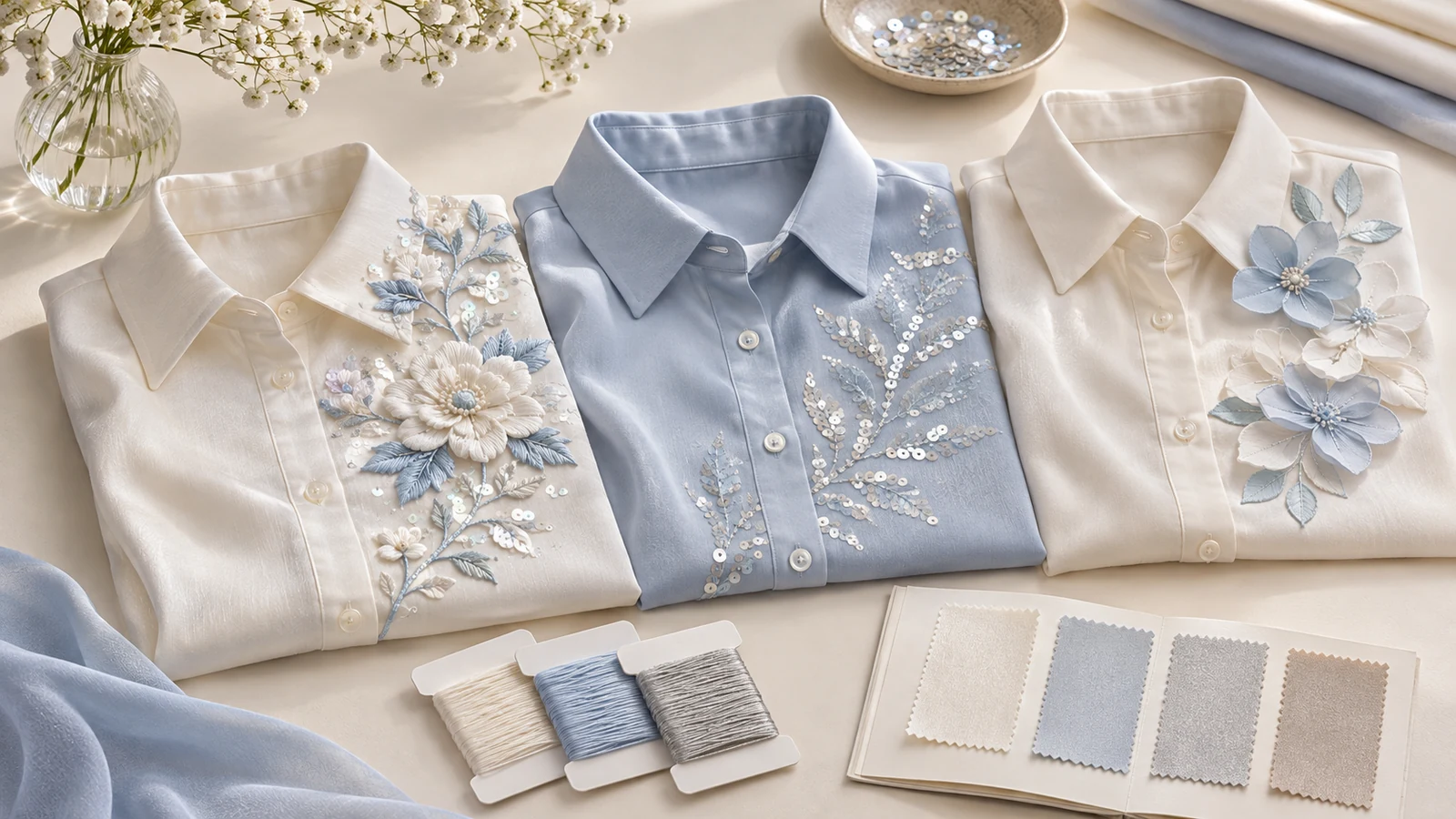
Decoration can turn a familiar shirt silhouette into a recognizable private-label product, but the technique needs to match the fabric, target price, wear occasion and care requirements. Embroidery, sequins and applique each create a different visual effect and introduce different production controls. This guide helps importers, wholesalers and brand buyers prepare a clearer decoration brief before sampling.
Start With the Commercial Goal
Before choosing a technique, define what the garment must achieve. A boutique statement shirt may support dimensional flowers and reflective accents, while a repeatable everyday style may need a flatter, softer motif. Consider the target customer, retail environment, expected care method, order volume and the role of the decorated item within the wider collection.
Technique Comparison
| Technique | Best For | Key Development Questions |
|---|---|---|
| Embroidery | Durable motifs, line work, tonal or multicolor artwork | Stitch density, backing, thread type, placement and fabric stability |
| Sequins | Reflective highlights and occasion-led fashion | Sequin size, color, attachment method, spacing and abrasion risk |
| Applique | Dimensional petals, stars, patches and mixed-material effects | Edge finish, attachment, layer thickness and wash behavior |
| Combined decoration | Premium statement pieces with several textures | Artwork hierarchy, total weight, hand feel and inspection standard |
Embroidery: Control Density and Fabric Stability
Embroidery is versatile, but more stitches do not automatically mean better quality. Dense artwork can make a lightweight shirt feel rigid or cause puckering around the motif. The sample should confirm the correct stabilizer, thread tension and stitch direction for the selected fabric. Buyers should approve artwork size, placement measurements, thread colors and the appearance of both the face and reverse of the embroidery.
Lightweight or semi-sheer fabrics require particular care. The backing should support the motif without creating a heavy visible patch. For textured fabrics, the stitch plan may need adjustment so the motif remains readable without flattening the surface.
Sequins: Specify the Reflective Effect
Sequins can be used as a full surface treatment or as restrained highlights within embroidery. A useful brief identifies sequin diameter, shape, color, finish, spacing and attachment method. It should also state whether the intended effect is subtle daylight sparkle or a stronger evening look.
Inspection should cover loose or missing sequins, sharp edges, consistent spacing and secure thread ends. If sequins are placed near the underarm, cuff or side seam, the sample should be checked for comfort and abrasion during movement.
Applique: Build Dimension Without Losing Wearability
Applique adds volume by attaching a separate fabric or formed component to the garment. It works well for dimensional flowers, stars and graphic motifs. The base and applique materials should be evaluated together because different shrinkage or stiffness can distort the finished panel after washing.
For floral applique, confirm the number of layers, petal shape, edge treatment and how much movement is acceptable. A dramatic three-dimensional effect may suit a statement piece, but the same construction may be too bulky for a shirt designed for frequent layering.
When to Combine Techniques
Combining embroidery, sequins and applique can create a distinctive premium product, provided one technique leads the design. Without a clear hierarchy, the result can feel heavy and increase inspection complexity. A practical approach is to use embroidery for the main artwork, applique for selected focal elements and sequins as controlled highlights.
What to Include in the Decoration Brief
- Vector artwork or a high-resolution reference with dimensions
- Exact placement measured from stable garment points
- Thread, sequin and applique color references
- Approved decoration technique and attachment method
- Acceptable tolerances for placement, size and color
- Care expectations and any required testing
- Reference photos showing the desired dimensional effect
Quality-Control Checkpoints
A decoration approval should be part of the pre-production sample, not left until bulk inspection. During production, checks can cover motif position, stitch consistency, puckering, loose threads, missing components, color matching and reverse-side finishing. Final inspection should compare the bulk garment with the approved sample under consistent lighting.
Choosing the Best Option for Your Program
Choose embroidery when durability and precise artwork are the priority. Choose sequins when controlled reflection supports the collection story. Choose applique when physical dimension is essential. Combine techniques when the additional visual value justifies the extra sampling and inspection work. Exact feasibility, minimum quantities and lead time depend on the artwork, materials and order specification, so these should be confirmed after the development brief is reviewed.
Related Product Examples
See how different decorative directions appear across our white sheer floral embroidered shirt, white pink floral embroidered shirt and brown corduroy sequin star shirt.
FAQ
Can decoration artwork be customized?
Yes. Motif, placement, colors and technique can be reviewed for OEM/ODM development.
Which technique is best for lightweight fabric?
The answer depends on fabric stability and the desired effect. Lower-density embroidery or restrained embellishment is often easier to balance on lightweight materials.
Can several techniques be used on one shirt?
Yes, subject to sample approval, garment comfort and production feasibility.
How are decoration costs confirmed?
Quotation requires the artwork, size, placement, materials, quantity and inspection requirements.
Request a Development Review
Send Zuohan Clothing your artwork, target fabric, placement, size range, order volume and reference images. Our team can review the concept and discuss appropriate sampling, labeling and export packing options.


